Week 37
Your baby is the size of a
Swiss Chard
48.6 cm
Length
2.9 kg
Weight
37 Weeks Pregnant: Early Term - Your Baby Could Arrive Any Day
At 37 weeks pregnant, you’ve reached an exciting milestone: early term! Your baby is about the size of a bunch of Swiss chard, measuring around 19.1 inches (48.6 cm) from head to heel and weighing approximately 6.3 pounds (2.9 kg). Your baby is now considered mature enough to be safely born, though staying pregnant until at least 39 weeks allows for optimal development.
What’s Happening at 37 Weeks Pregnant?
Welcome to early term! The American College of Obstetricians and Gynecologists (ACOG) defines pregnancy term stages as:
- Early term: 37 weeks 0 days through 38 weeks 6 days
- Full term: 39 weeks 0 days through 40 weeks 6 days
- Late term: 41 weeks 0 days through 41 weeks 6 days
- Postterm: 42 weeks 0 days and beyond
While your baby could safely arrive now, research shows that babies born at 39-40 weeks (full term) have better outcomes than those born at 37-38 weeks (early term). Unless there’s a medical reason for early delivery, staying pregnant until 39 weeks is ideal.
That said, reaching 37 weeks is a significant accomplishment! You can breathe a bit easier knowing that if labor begins spontaneously, your baby is mature enough for life outside the womb.
Your prenatal visits are now weekly, and your provider will monitor you and your baby closely for signs that labor is approaching.
How Big is My Baby at 37 Weeks?
Your baby at 37 weeks is about the size of Swiss chard or a winter melon, measuring approximately 19.1 inches (48.6 cm) from crown to heel.
Weight-wise, your baby now weighs around 6.3 pounds (2.9 kilograms), though this can vary significantly—anywhere from 5.5 to 7.5 pounds is normal at this stage. Your baby will continue gaining weight until delivery, though the rate may slow slightly.
Baby Development at 37 Weeks
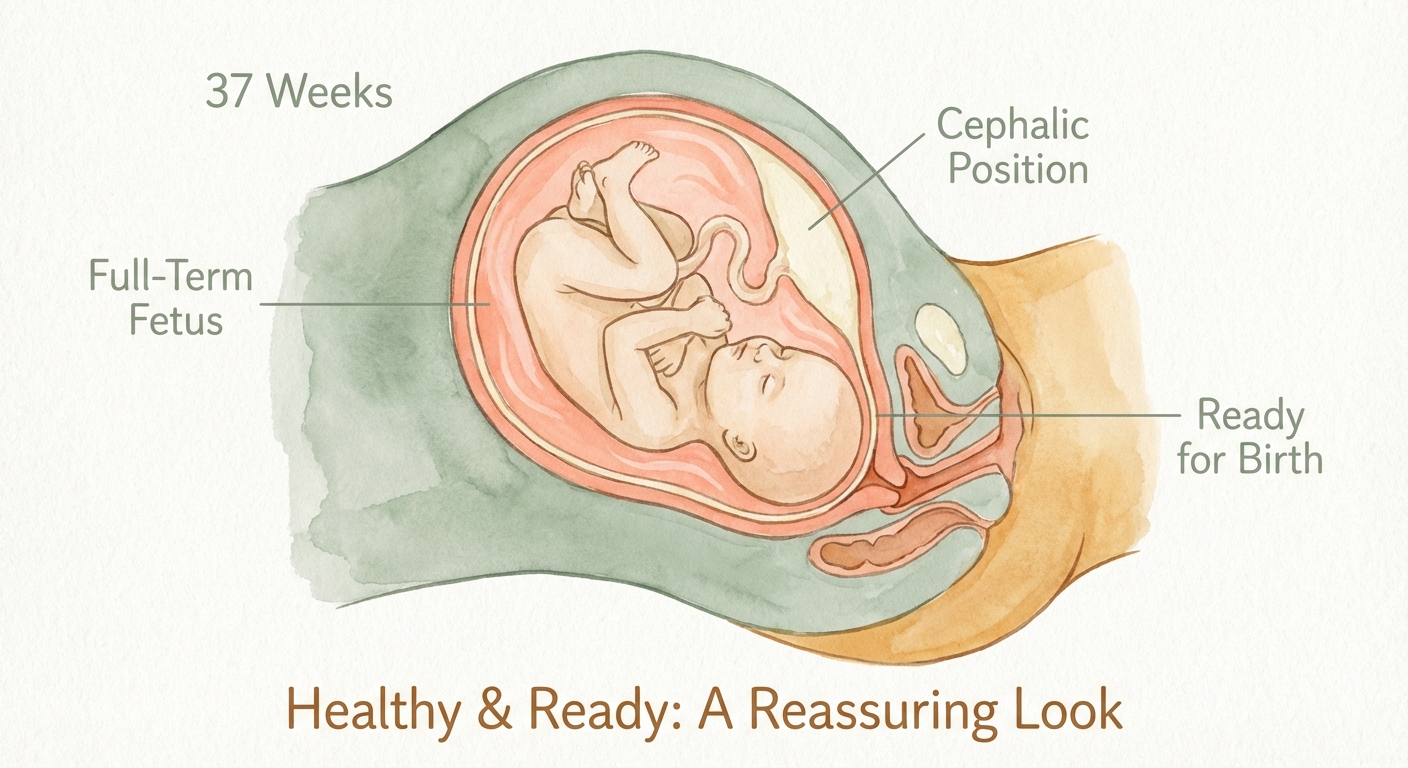
Your baby is essentially fully developed:
Lungs fully mature: Surfactant production is sufficient for breathing air. Babies born at 37 weeks typically don’t need respiratory support (though some early-term babies do require short-term help).
Brain maturation: Your baby’s brain continues developing rapidly, forming neural connections that will continue through early childhood. The brain is now capable of coordinating all the functions needed for life outside the womb.
Fat stores: Your baby has accumulated significant fat stores (about 15% of body weight is fat), which helps with temperature regulation and provides energy reserves after birth.
Digestive system ready: Your baby’s digestive tract is mature and ready to process breast milk or formula, though the gut microbiome won’t be established until after birth through exposure to beneficial bacteria.
Immune system: While still immature, your baby’s immune system is functional. They’ve received antibodies from you through the placenta and will get more through colostrum and breast milk (if you breastfeed).
Movement changes: With limited space, your baby’s movements may feel different—more stretching and squirming, less rolling. You should still feel regular movement daily.
Dropping/lightening: Many first-time pregnancies experience “lightening” (baby dropping into the pelvis) around this time, though for subsequent pregnancies, this often doesn’t happen until labor begins.
Skull bones remain soft: The bones of your baby’s skull remain soft and separated by fontanelles (“soft spots”), allowing the head to mold during passage through the birth canal.
Signs Labor May Be Approaching
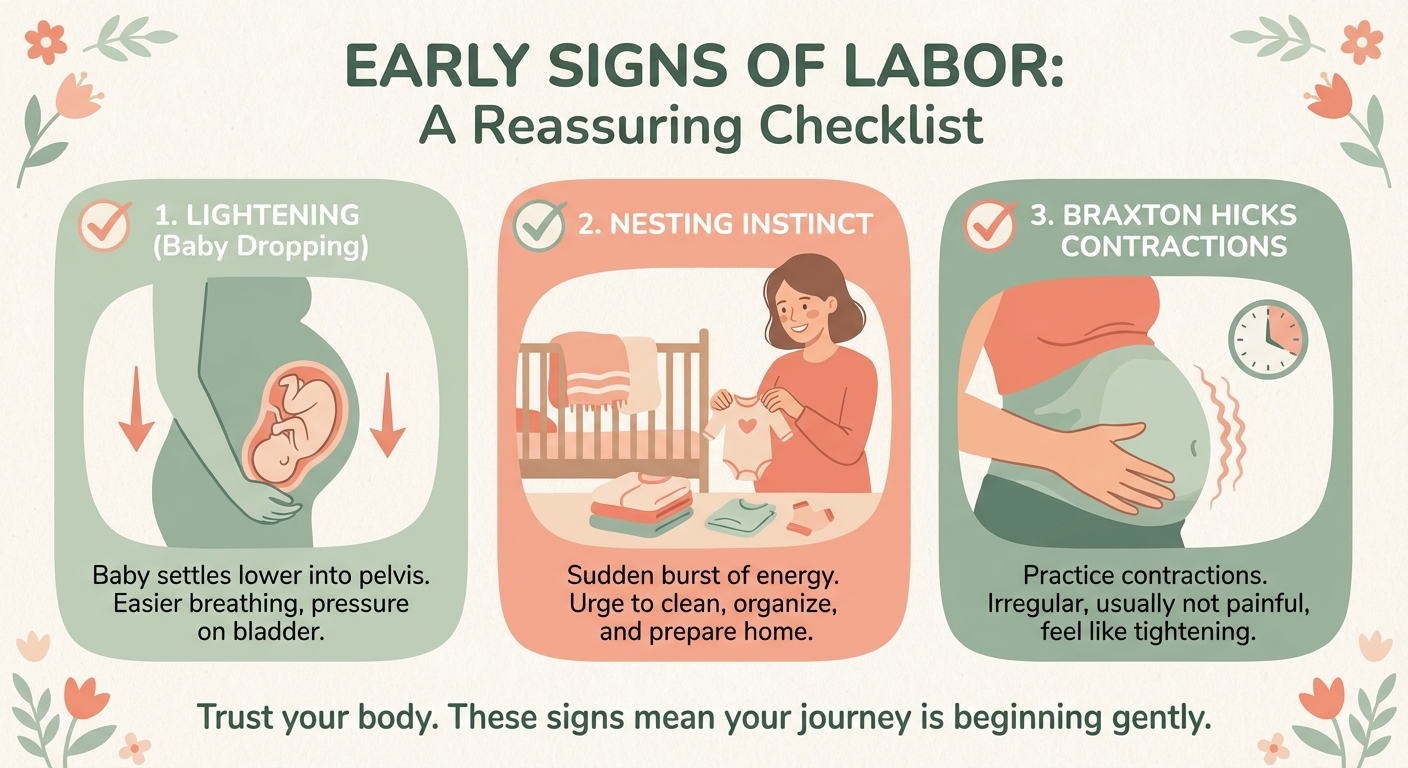
Watch for these signs that labor could be near:
Baby dropping (lightening): If you haven’t experienced this yet, you may notice your baby settling lower into your pelvis. Breathing becomes easier, but pelvic pressure increases.
Increased Braxton Hicks: Practice contractions may become more frequent and intense.
Cervical changes: Your provider will check your cervix at appointments for dilation (opening) and effacement (thinning). Some dilation before labor is normal and doesn’t necessarily mean labor is imminent.
Bloody show: You may pass the mucus plug that sealed your cervix during pregnancy. It appears as thick mucus with streaks of blood. This can happen days or weeks before labor.
Nesting instinct: A sudden burst of energy and desire to organize and clean is common in the final weeks.
Diarrhea: Hormonal changes that prepare your body for labor can cause loose stools.
Water breaking: Only about 10% of labors begin with water breaking, but it can happen. If your water breaks (gush or steady leak), contact your provider immediately—labor typically begins within 24 hours.
When to Go to the Hospital
Know when to head to the hospital or call your provider:
Regular contractions: The 5-1-1 rule is common guidance—contractions 5 minutes apart, lasting 1 minute each, for 1 hour. However, your provider may give different instructions based on your situation.
Water breaking: If your water breaks, contact your provider right away, even if you’re not having contractions.
Bleeding: More than light spotting requires immediate attention.
Decreased fetal movement: If you notice significantly reduced movement, call your provider.
Severe pain: Intense, constant abdominal pain (not contraction pain that comes and goes) needs evaluation.
Signs of preeclampsia: Severe headache, vision changes, or upper abdominal pain with swelling.
Tips for Week 37
Have hospital bag ready: Make sure it’s packed with everything you need for labor, delivery, recovery, and going home.
Know the route: Drive to the hospital during different times of day to know the best route and where to park.
Keep phone charged: Labor could start any time. Keep your phone charged and with you.
Rest as much as possible: Labor is physically demanding. Rest whenever you can.
Stay active gently: Walking can help encourage your baby to move into an optimal position, but don’t overdo it.
Eat nutritious foods: You need energy for labor. Focus on nutrient-dense foods and stay hydrated.
Practice relaxation: Use breathing exercises, meditation, or visualization to stay calm.
Communicate with your provider: Ask any final questions about labor, delivery, or postpartum care.
Prepare for breastfeeding: If planning to breastfeed, review basics so you know what to expect.
Have support ready: Make sure your support person knows the plan and is available.
Understanding Early Term vs. Full Term
While babies born at 37 weeks are considered mature, research shows advantages to reaching 39 weeks:
Brain development: The fetal brain grows about one-third its adult size between weeks 35-39.
Lung maturity: While lungs are functional at 37 weeks, they continue maturing through 39 weeks.
Reduced complications: Babies born at 39-40 weeks have lower rates of respiratory problems, feeding difficulties, and NICU admission compared to early-term babies.
Better outcomes: Full-term babies generally have better long-term developmental and health outcomes.
For these reasons, unless there’s a medical reason for induction, waiting until 39 weeks is recommended. That said, if spontaneous labor begins at 37-38 weeks, your baby is mature enough to do well.
Record the Final Stretch with Nooko
Follow your current week and due-date countdown, use the kick counter to record count-to-10 sessions and elapsed time, and use the contraction timer to record duration and spacing. Session histories and some other features require Nooko+.
Nooko does not monitor your baby, assess labor, or decide when you should seek care. Follow your healthcare professional’s movement-counting and labor plan, and contact them promptly about changes or concerns.
Download Nooko on the App Store
References
- American College of Obstetricians and Gynecologists. (2025). “How Your Fetus Grows During Pregnancy.” https://www.acog.org/womens-health/faqs/how-your-fetus-grows-during-pregnancy
- American College of Obstetricians and Gynecologists. (2013). “Definition of Term Pregnancy.” Committee Opinion No. 579. https://www.acog.org/clinical/clinical-guidance/committee-opinion/articles/2013/11/definition-of-term-pregnancy
- ACOG. (2013). “Definition of Term Pregnancy.”
- BabyCenter. (2025). “37 Weeks Pregnant.” https://www.babycenter.com/pregnancy/week-by-week/37-weeks-pregnant
- Merck Manual. (2025). “Respiratory Distress Syndrome in Newborns.” https://www.merckmanuals.com/home/children-s-health-issues/lung-and-breathing-problems-in-newborns/respiratory-distress-syndrome-in-newborns
- Tommy’s. (2025). “Your baby’s movements in pregnancy.” https://www.tommys.org/
- American College of Obstetricians and Gynecologists. (2025). “How to Tell When Labor Begins.” https://www.acog.org/womens-health/faqs/how-to-tell-when-labor-begins
- ACOG. (2025). “How to Tell When Labor Begins.”
Get Nooko Updates
Pregnancy tips and product updates, sent occasionally.
No spam. Privacy policy. Consumer health privacy. Unsubscribe anytime.
Ready to start tracking?
Download Nooko free — your pregnancy companion from week 1 to birth.